
Bottle Priming Sugar Calculator
Calculate exact priming sugar weights based on style CO2 volumes, batch volume, and fermentation temperature.
Bottle Priming & Carbonation
Accurate sugar weights accounting for residual dissolved CO2 from fermentation temperature.
Required Priming Sugar (Choose One):
Henry's Law Residual CO2 & Priming Mass Equation
CO_{2\text{ dissolved}} = 3.0378 - 0.050062 T + 0.00026555 T^2Beer contains residual dissolved carbon dioxide from primary fermentation inversely proportional to its highest fermentation temperature. The sugar required is only the delta between target volumes and residual dissolved gas.
- 1Enter exact volume of beer transferred to bottling bucket (e.g. 5.0 gallons).
- 2Enter the highest temperature the beer reached post-fermentation (e.g. 68°F).
- 3Select your beer style or enter custom target volumes of CO2 (e.g. 2.4 vols for American Ale).
- 4Weigh the calculated sugar in grams on a digital scale, boil in 1 cup water, and mix gently into the bottling bucket.
Recommended Equipment for this Tool
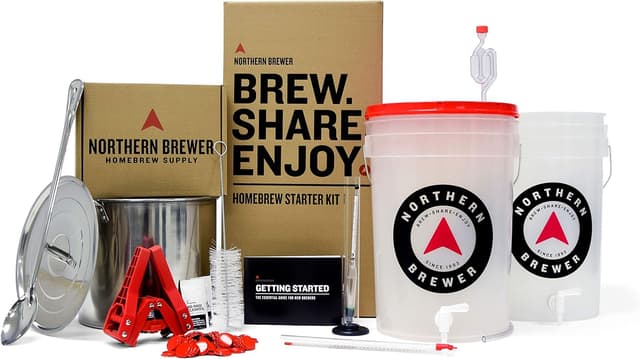
Northern Brewer Brew. Share. Enjoy. Homebrew Starter Kit
Most starter kits cut corners with flimsy airlocks, cheap plastic siphons, and unclear instructions that lead to frustration. Northern Brewer's flagship kit features food-grade fermenters with built-in spigots, a true spring-loaded bottle filler, hydrometer with test jar, capper, caps, sanitizer, and a complete recipe kit with fresh malt extract and specialty grains.
Why should I enter the highest post-fermentation temperature?
Because gas solubility follows Henry's Law: once beer warms up, dissolved CO2 escapes through the airlock. Even if you subsequently cold-crash to 35°F, CO2 does not re-enter unless pressurized. Always use the highest temperature reached after fermentation ended.
Can I use regular table sugar (sucrose) instead of corn sugar (dextrose)?
Yes! Sucrose works wonderfully and is 100% fermentable. Because corn sugar contains ~9% water of crystallization (dextrose monohydrate), you need ~9% less table sugar by weight than corn sugar for the identical carbonation level.
Explore Other Brewing Tools
View All 8 ToolsPut This Tool Into Practice
Test your brew day calculations against authentic BJCP style profiles and all-grain grain bills: